Sheet Metal Formed to Exact Angles
Bending Services in Nampa for Fabricated Components Requiring Dimensional Accuracy
Flat sheet metal becomes functional enclosures, brackets, panels, and structural components only after precise bending operations create the required angles and contours. Treasure Valley CNC operates bending equipment with 100 tons of forming capacity, capable of bending material up to 8 feet wide along straight or complex profiles. This capacity supports manufacturing and fabrication projects across Nampa and the Treasure Valley, where laser-cut components are formed into finished assemblies without outsourcing or dimensional inconsistency.
Accurate bends matter because misaligned angles cause assembly problems, create gaps in welded seams, and prevent components from fitting into fixtures or enclosures. Tonnage, tooling selection, and bend sequence are adjusted based on material thickness, grain direction, and springback characteristics to produce repeatable angles.
Arrange an evaluation to discuss material specifications, bend angles, and tolerances required for your fabrication project.
What Happens During Precision Bending
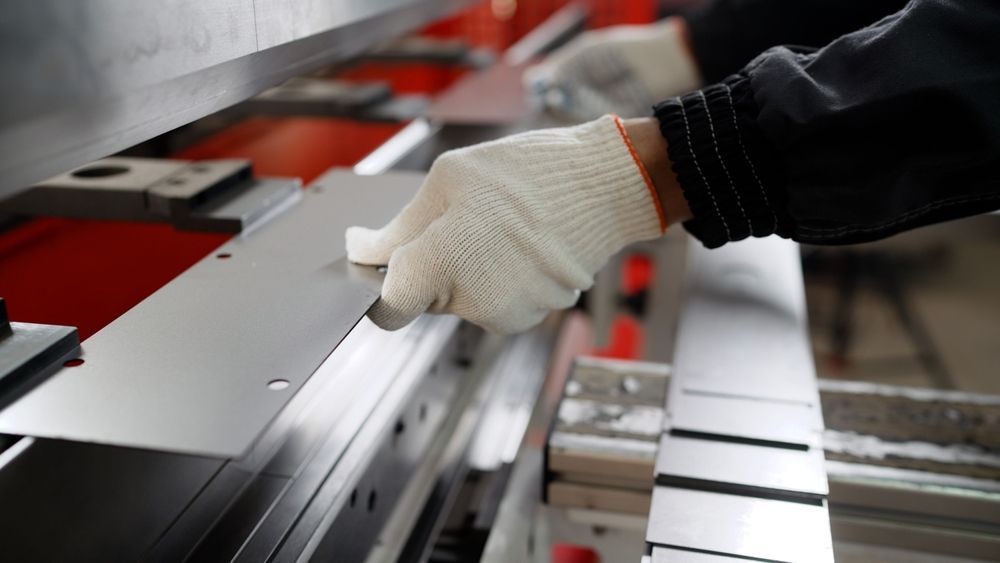
Sheet metal is positioned against tooling and pressed with controlled force to achieve specific bend angles. The press brake calculates tonnage distribution across the bed length to prevent deflection and maintain consistent angles on wide or thick material. Bend allowances and K-factors are programmed to account for springback, ensuring final angles match design specifications after material relaxation.
Completed parts align correctly during assembly, with flanges meeting at proper angles and bolt holes lining up without forcing. Welded seams form tight joints, enclosures close without gaps, and components fit into mounting fixtures as designed. Multiple bends on a single part remain dimensionally consistent across production runs.
Bending integrates seamlessly with laser cutting at Treasure Valley CNC, allowing flat patterns to move directly from cutting to forming without intermediate handling or transportation. This coordination reduces lead times and ensures that cut edges and bend lines remain aligned according to digital models.
Common Bending Service Questions
Manufacturers and fabricators ordering custom bent components typically need information about material limits, tooling options, and production consistency.
What materials can the press brake form?
The equipment bends steel, stainless steel, aluminum, and other sheet metals up to 8 feet wide, with tonnage limits determined by material thickness and tensile strength.
How is bend accuracy maintained across wide material?
The 100-ton press distributes force evenly across the bed length, preventing deflection that causes angle variation between the center and edges of wide sheets commonly bent in Nampa fabrication shops.
What factors affect bend quality?
Material grain direction, thickness consistency, and surface condition all influence how metal responds to forming pressure, with tooling and tonnage adjusted to compensate for variation.
Can bending be coordinated with laser cutting?
Laser-cut blanks proceed directly to the press brake without additional handling, ensuring that cut edges, holes, and bend lines remain aligned according to programmed dimensions.
How does springback affect final angles?
Metal partially returns to its original shape after forming pressure is released, requiring overbending to compensate so that final angles match design specifications once the part relaxes.
Treasure Valley CNC provides quotes for bending services based on material type, thickness, bend complexity, and production volume. Call (208) 272-0554 to review your project requirements and discuss fabrication options.